Monday, 1 October 2018

Surprising facts about the Sustainable Development Goals


The United Nations set out the Sustainable Development Goals (SDG) in 2015 to save our planet (from us) and the future generation (from the present).

Some of the (surprising) facts of SGD are listed below –

1. No more extreme poverty by 2030:
The first SDG focuses on eradicating extreme poverty i.e. people living below $1.25 per day by 2030.What most people do not know is that proportion of people living in extreme poverty in the last 20 years has halved! 
That’s pretty incredible and makes this goal seem less unrealistic as one might initially think.

2.     Healthier and safer mankind:
The aim of the third SDG is to end the epidemic of AIDS, TB, and Malaria. If that sounds too ambitious, here's an encouraging fact - polio killed on an average half a million people in the 1940s and 1950s each year… however, in 2017 only 22 cases of polio were reported.
 The UN is banking on such trends and is also looking to halve all road accidents by 2020.

3.     Halving food wastage:

SDG 12 aims at halving the food wastage by 2030 at the retail and consumer levels. It doesn’t sound too ambitious but with the present scale of food wastage, it will be a resounding success if it can be achieved.

4.    The annual 100 Billion Dollar fund:
By 2020, the developed countries have a goal of raising 100 billion dollars each year to aid the developing world in combating climate change. 
As of May 2018 only USD 10.21 Billion has been announced and signed (it is reasonable to expect that the 100 Billion will fail to materialize).

5.    Data and debt management:
A commitment is made to support the availability of high quality, timely and reliable data to the developing countries (if you can’t measure it, you can’t control it).
Moreover, debt-relief and debt restructuring to poor countries is also high on the agenda.

6.    A meeting every four years:
To identify progress and the emerging challenges to take further actions, meetings are planned for every four years. The next meeting is to be held in 2019. However, none of these goals are (unfortunately) legally binding.

7. The current status:
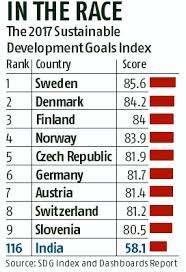
Sweden is the country at the top and it is closest to achieving the SDG with other Scandinavian countries close behind. 
Central African republic comes in last while Canada is 20th out of the 156 countries evaluated on the SDG Index.

Thursday, 20 September 2018

Green Bonds and why they make sense!

Apart from James, the hottest (or coolest, if you like) Bond you need to know about is Green. Green Bonds beautifully combine sustainable goals with financial ones and are gaining popularity rapidly across our pale blue dot.
Here's what they are about, summarized in five simple points -

1. Core components -

A green bond is a financial instrument whose proceeds will be used exclusively for Green Projects that are aligned with the core components of the Green Bond Principles (GBP). These core principles are as follows -
a. Use of proceeds (how you use the money raised)
b. Process for Project Evaluation and Selection (involving environmental sustainability objectives)
c. Management of proceeds (ensuring high level of transparency)
d. Reporting (annual reports with quantitative performance indicators)

2. The five high level environmental objectives -

These objectives are climate change mitigation, climate change adaptation, natural resource conservation, biodiversity conservation and pollution prevention and control.

3. External reviews -
The issuer of Green Bonds can seek external review in the form of second party opinions, verifications, certifications and/or Green Bond rating.

4. Types of Green Bonds -

There are many types of Green Bonds in the market and the list is constantly growing. However, some of the common ones are Standard Green Use of Proceeds Bond, Green Revenue Bond, Green Project Bond and Green Securitised Bond.


5. Voluntary guidelines -

All of the principles for issuing Green Bonds are voluntary guidelines and are issued by the International Capital Market Association (ICMA). Local laws and regulations override these principles in case of any conflict.
The sharp growth of Green Bonds across the globe is shown by the graph (source - Bloomberg) where the capital raised has sky-rocketed from under $40B in 2014 to over $160B in 2017.
Fun fact - The Province of Ontario successfully raised $1 billion through issue of Green Bonds in Jan, 2018 and has raised over $3 billion through all the issues combined.

To learn more about Green Bonds, you can read at -
https://www.icmagroup.org/green-social-and-sustainability-bonds/resource-centre/


How to deal with AI when it comes for your job

If you have ever worried about your job/livelihood with the rise of AI - such headlines don't help. E.g. The Guardian - A robot wrote th...